EN


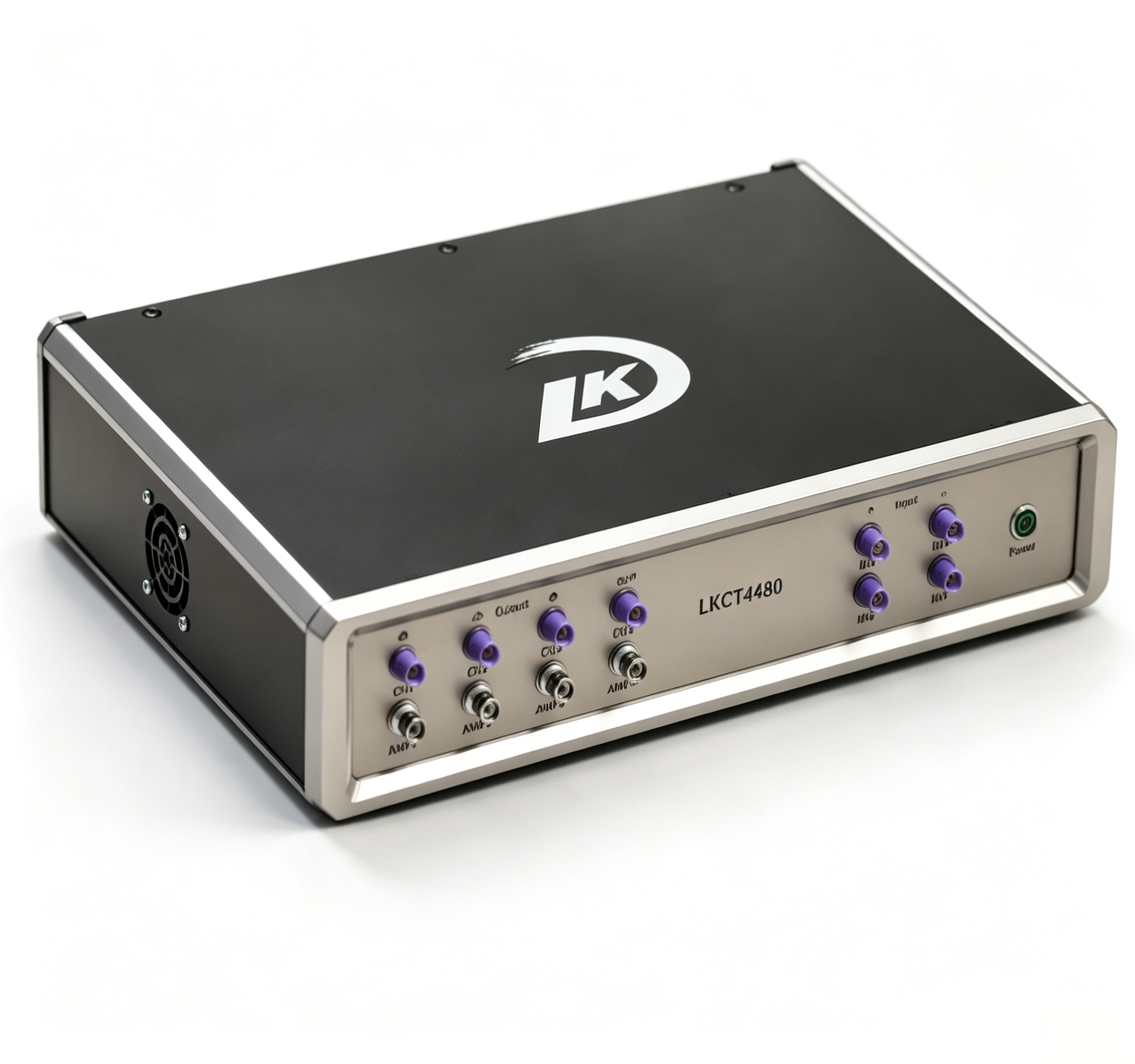
Product Overview
The Comprehensive Audio Test System integrates an audio interface, power amplifier, and signal conditioning module into a single platform, providing a complete solution for electroacoustic testing.
Equipped with 4 input channels and 4 output channels, the system supports simultaneous audio signal generation and acquisition. It features low noise, ultra-low distortion, and excellent frequency stability. When combined with host computer test software and acoustic measurement algorithms, it enables fast and accurate measurement of key acoustic parameters for a wide range of electroacoustic products.
The system is suitable for both laboratory R&D and automated mass-production testing.
Specifications
Sampling Rate: 44.1 kHz–192 kHz
Resolution: 32-bit
Coupling: AC / DC
Channels: 4 Inputs + 4 Outputs
4 Inputs — Line / Mic |
|
4 Outputs — 2 × Line + 2 × Amplifier | Line Output
Amplifier Output — 2 Channels, Single-Ended
|
Application Scenarios
- Acoustic performance testing of TWS earbuds, headphones, and wired earphones
- Acoustic parameter testing of smart speakers, loudspeakers, receivers, and microphones
- Acoustic testing of mobile phones, intercom systems, and automotive voice terminals
- Algorithm verification for noise-cancelling microphones and speech recognition devices
- Performance evaluation and R&D testing of electroacoustic devices
- In-line acoustic testing for automated consumer electronics production lines
Recommended System Configuration
The instrument can be used together with soundproof test enclosures, artificial mouths, self-developed test speakers, standard measurement microphones, and other acoustic accessories to form a complete acoustic testing system.
Typical Test Process
Audio Test System outputs a test signal → Sound source generates the acoustic signal → DUT receives or reproduces the signal → Audio Test System acquires the DUT output signal → Host computer software automatically analyzes and calculates the required acoustic parameters.
Customization
Expansion Explanation
The standard 4-input, 4-output configuration meets most conventional electroacoustic testing requirements.
For applications requiring additional channels, higher output power, special interfaces, or other customized hardware configurations, tailored solutions are available based on specific test requirements.
 Tel:173 9470 0835
 E-mail:support@lk-tek.com
 Add:No. 246 Wencheng East Road, Siyang County Economic Development Zone, Suqian City, Jiangsu Province