EN


This solution is designed for comprehensive acoustic testing applications across various consumer electronic products. By integrating standardized acoustic testing equipment and professional analysis algorithms, it enables data-driven, high-precision, automated, and traceable evaluation of product acoustic performance, covering the entire process from R&D debugging and acoustic tuning to mass production testing.
Bluetooth earphones, headphones, smartphones, tablets, laptops, AR/VR smart devices, smart speakers, and various consumer electronic terminals equipped with audio transmission and receiving capabilities.
Calibration and evaluation of key acoustic parameters, including frequency response characteristics, signal-to-noise ratio (SNR), harmonic distortion, loudness consistency, maximum sound pressure level (SPL), and other critical indicators.
Evaluation of microphone sensitivity, background noise suppression capability, frequency response consistency, call clarity, and near-field/far-field sound pickup performance.
Quantitative verification of active noise cancellation (ANC) depth, noise reduction frequency-band coverage, transparency mode fidelity, and noise resistance performance under complex acoustic environments.
Testing of speech recognition accuracy, wake-up sensitivity, and anti-interference interaction stability under both quiet and noisy environments.
Comprehensive acoustic parameter screening for mass-produced devices, enabling rapid identification of defects such as sound distortion, abnormal audio pickup, and noise reduction failures, ensuring consistent product quality and user experience.
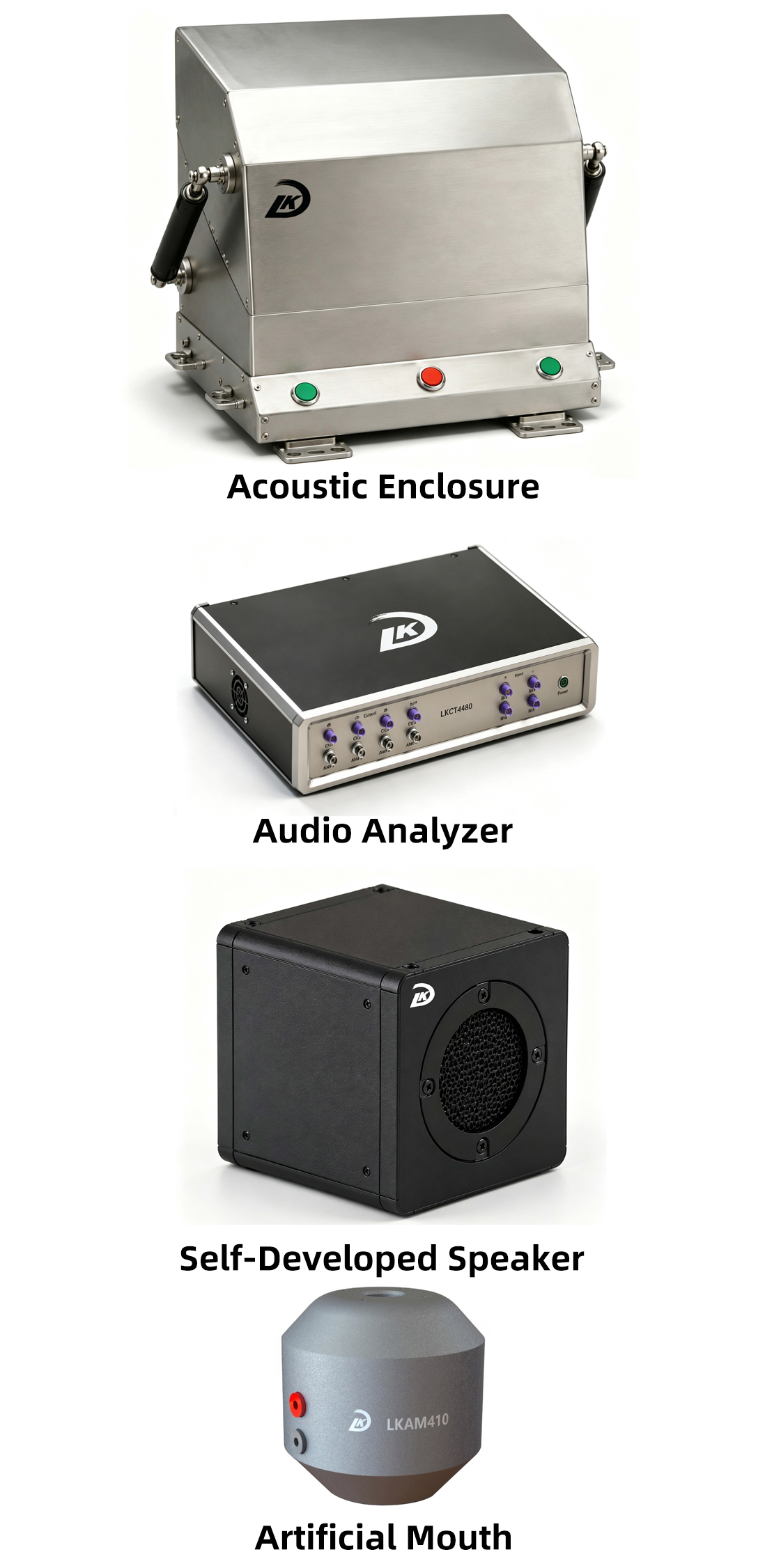
Liankang independently develops comprehensive acoustic testing equipment, including standard artificial mouths, reference sound source speakers, and other professional acoustic testing instruments. These systems provide high measurement accuracy, excellent stability, and strong repeatability.
Equipped with fully self-developed acoustic analysis software, the system supports automated test workflow configuration, real-time data acquisition, frequency response curve generation, parameter comparison analysis, and test data storage and traceability.
The solution integrates high-performance professional sound isolation equipment and customized acoustic fixtures to effectively reduce external noise and vibration interference, creating a stable and standardized acoustic testing environment. It ensures accurate and reliable test results while supporting customized fixture solutions for different product structures and testing requirements.
Independently developed acoustic testing instruments, analysis software, sound isolation equipment, and customized fixtures provide highly integrated solutions with excellent cost efficiency, flexible technology upgrades, efficient on-site debugging, and reliable after-sales support.
Supporting a wide range of consumer electronic audio products, including headphones, smartphones, computers, AR/VR devices, and smart speakers. The solution can adapt to multi-product and multi-model testing requirements across different production lines.
The solution integrates R&D acoustic tuning standards with mass production quality inspection standards, addressing industry challenges such as excellent prototype sound quality but inconsistent user experience among mass-produced products.
By using quantitative instrument-based measurement data as the evaluation basis, the solution eliminates subjective errors caused by manual listening tests. It supports automated batch testing, data archiving, and traceability, meeting enterprise quality management and compliance requirements.
Based on customer product structures, acoustic testing specifications, and production line layouts, Liankang provides customized sound isolation fixtures, adaptive fixtures, and automated testing solutions to address testing challenges for irregular products and special application scenarios.
The solution is widely applied throughout the entire acoustic product lifecycle, including acoustic R&D, tuning, audio performance calibration, noise reduction verification, voice interaction testing, whole-device acoustic reliability testing, automated production-line testing, finished-product quality inspection, and batch quality control.
It provides core testing technology support for improving consumer electronics audio experiences, ensuring consistent product quality, and achieving efficient mass production.
 Tel:173 9470 0835
 E-mail:support@lk-tek.com
 Add:No. 246 Wencheng East Road, Siyang County Economic Development Zone, Suqian City, Jiangsu Province