EN


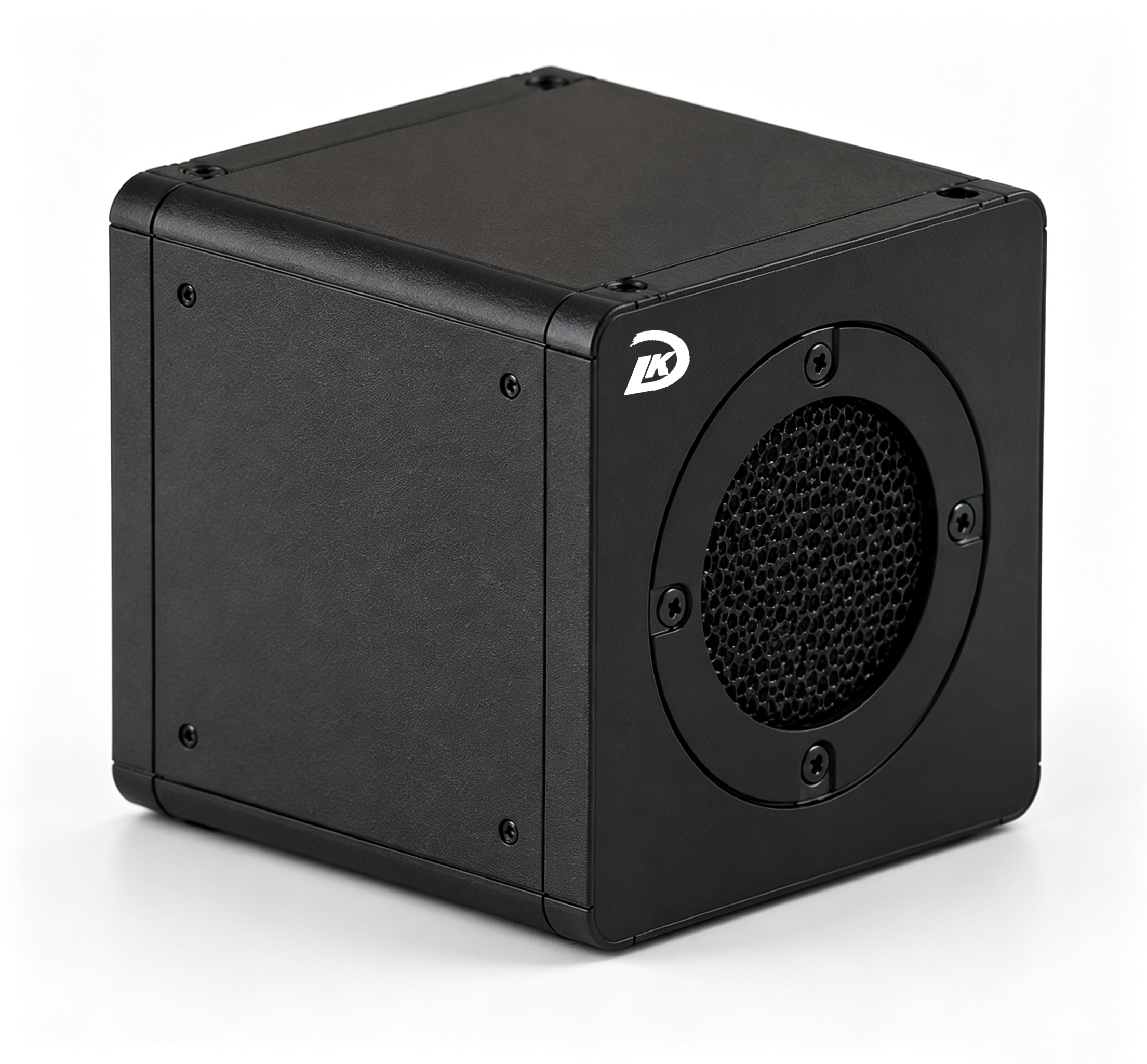
Product Overview
Our self-developed compact acoustic test speaker is designed for standard acoustic testing applications, providing a highly stable, low-distortion reference sound source.
Featuring a compact enclosure, wide frequency coverage, and sufficient sound pressure output, it meets the requirements of most conventional acoustic testing applications. Customized versions are also available, with adjustable distortion performance, enclosure dimensions, and acoustic parameters to accommodate specific test requirements.
Parameter | Specification |
THD(94 dB,25 mm MRP) | < 1% (100 Hz~10 kHz) |
THD(94 dB,100 mm MRP) | < 6% (100 Hz~200 Hz) ; < 1% (200 Hz~10 kHz) |
Impedance | 4 Ω |
Maximum Continuous Power | 30 W |
Weight | 1.9 kg |
Dimensions (L × W × H) | 130 mm × 130 mm × 110 mm |
Application Scenarios
✅ Acoustic performance testing of microphones and other sound pickup devices
✅ Comparative testing of electroacoustic devices such as headphones and speakers
✅ Reference sound source calibration in anechoic chambers and acoustic laboratories
✅ Speech algorithm and noise reduction algorithm data acquisition and testing
✅ Acoustic consistency testing of various audio devices
✅ Acoustic R&D and experimental testing in universities, research institutes, and enterprises
Customization
If the standard specifications do not meet your test requirements, customized solutions are available, including:
Customized enclosure dimensions
Optimized harmonic distortion performance for specific frequency ranges
Targeted adjustment of acoustic parameters such as frequency response and sound pressure level
Customized configurations based on specific acoustic test requirements
Please contact us with your specific test requirements for a tailored solution.
System Configuration Recommendations
For a complete acoustic testing system, it is recommended to use the speaker together with a professional power amplifier, acoustic data acquisition equipment, and acoustic test software.
Testing should be conducted in an acoustically controlled or sound-isolated environment whenever possible to minimize ambient interference and improve measurement accuracy
 Tel:173 9470 0835
 E-mail:support@lk-tek.com
 Add:No. 246 Wencheng East Road, Siyang County Economic Development Zone, Suqian City, Jiangsu Province