EN


Main functions
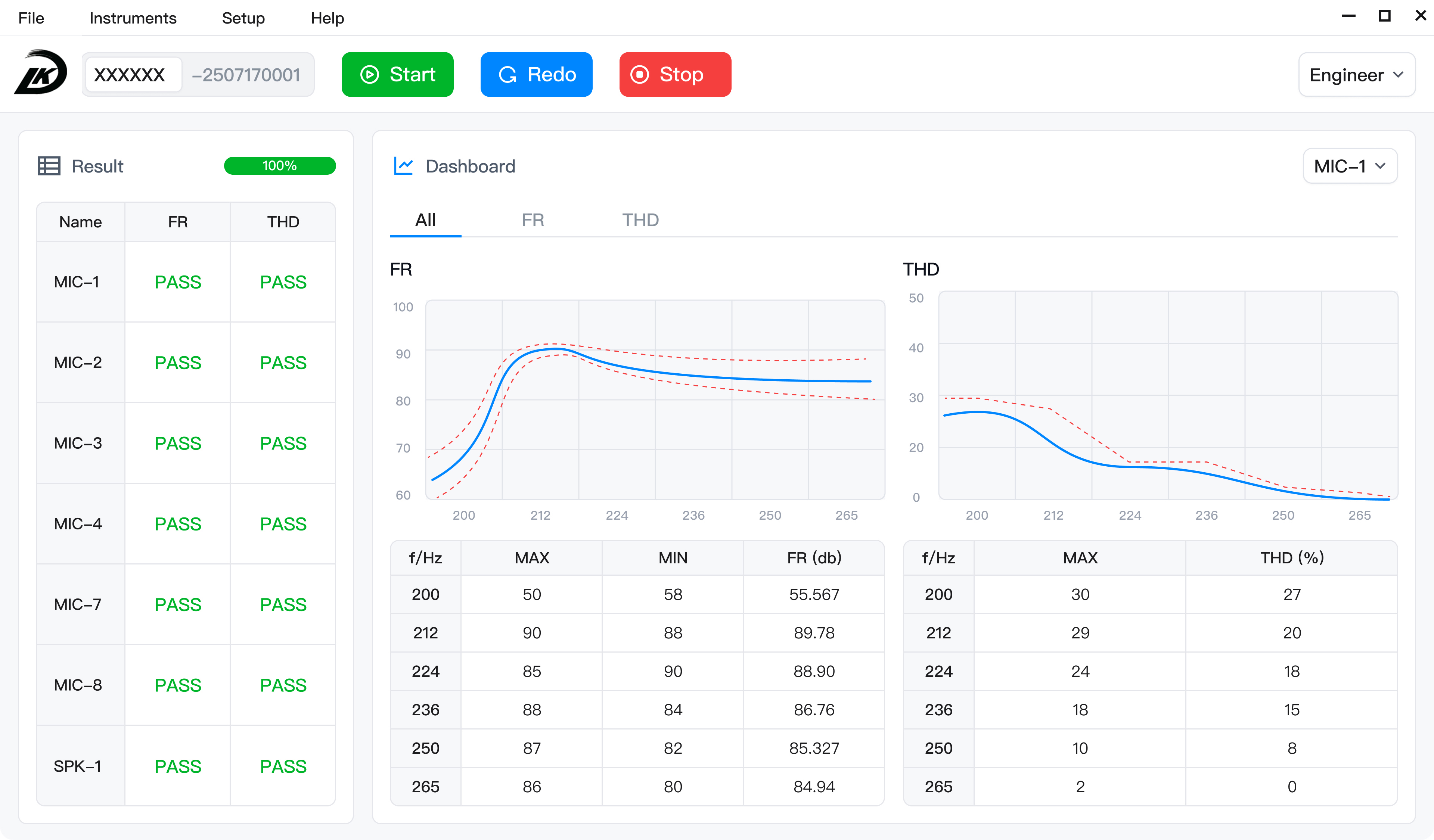
The system features a real-time monitoring dashboard that centrally displays multi-channel frequency response (FR) and total harmonic distortion (THD) curves, PASS/FAIL results, and test progress, providing a clear overview of the entire test process.
Built-in signal generator and oscilloscope modules support sine-wave signal generation, real-time waveform acquisition, and switching between Spectrum and THD views, helping engineers perform debugging and quickly locate test abnormalities.
The hardware configuration module supports ASIO drivers, sampling rates of 44.1 kHz, 48 kHz, 96 kHz, and 192 kHz, with a maximum bit depth of 24 bits. Input and output channel types can be flexibly configured, while parameters such as Vp and channel sensitivity can be accurately calibrated.
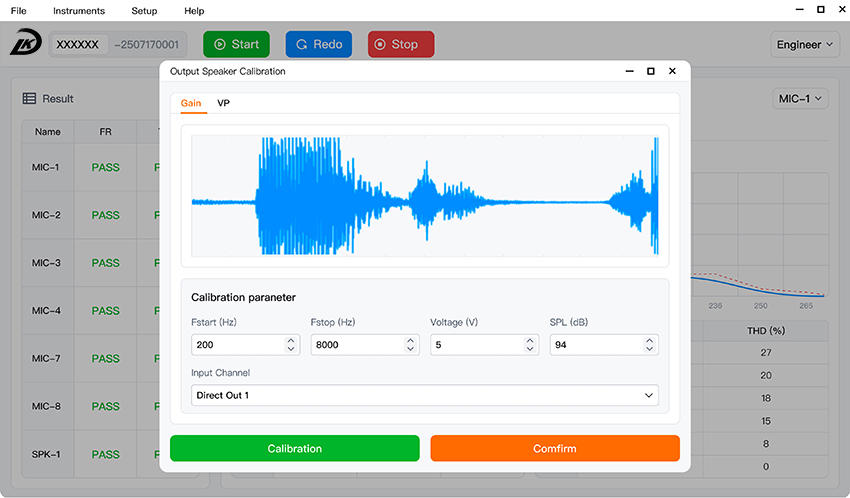
A complete calibration workflow is provided, including Vp calibration, speaker EQ calibration, microphone sensitivity calibration, and full-band speaker EQ sweep calibration, helping ensure the accuracy and consistency of test data.
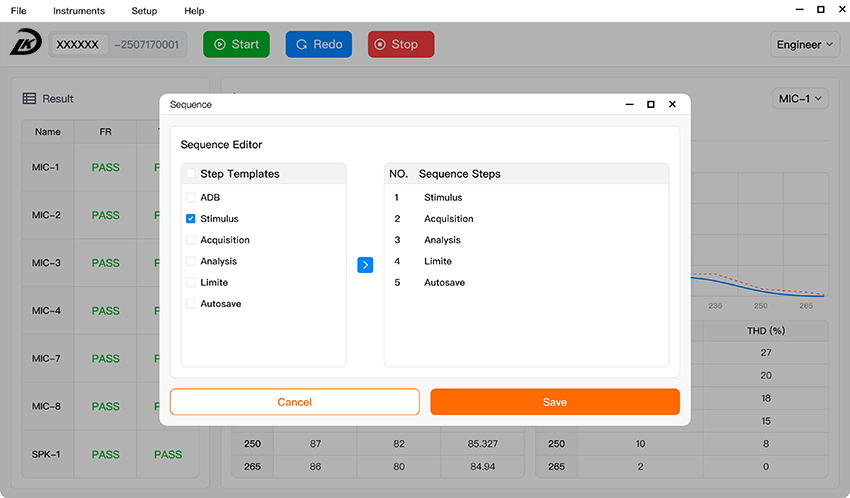
The test sequence includes six configurable step types:
Stimulus
Acquisition
Analysis
Limits
Auto Save
ADB Communication
These steps can be freely combined to build customized test sequences covering applications from engineering debugging and validation to automated mass production.
The system supports stepped frequency sweeps from 1/3 octave to 1/24 octave, as well as stepped amplitude sweeps. The configurable frequency range is 200 Hz–8000 Hz, with signal amplitudes ranging from 10 mV to 1 V.
Built-in analysis algorithms include Broadband RMS for fast frequency response measurement and HarmonicTrak for harmonic distortion analysis up to the 20th harmonic. Custom upper and lower limit curves can also be imported and exported.
The integrated ADB module supports Bluetooth device querying and custom command transmission, enabling integrated audio and Bluetooth testing for Android-based devices.
Technical Features
Multi-Channel Parallel Testing
Supports parallel testing and analysis of up to 8 microphones (MIC-1 to MIC-8) and 1 speaker (SPK-1). All channel data can be acquired and evaluated synchronously, significantly improving test throughput.
Real-Time FR & THD Monitoring
The monitoring dashboard displays frequency response and THD curves in real time. The frequency axis covers 200 Hz–265 Hz as currently specified and can be expanded, while the vertical axis displays MAX/MIN values.
Real-Time PASS/FAIL Results
The results panel displays the PASS/FAIL status of each channel together with overall test progress, allowing operators to quickly identify abnormal channels.
Channel-Level Data Analysis
Any channel can be selected to view detailed waveform and measurement data, making troubleshooting and problem localization more efficient.
Role-Based Access Control
Two user roles are supported:
Engineer: Full access to hardware settings, calibration data, test sequences, and system configuration
User: Limited to routine test operations such as Start and Stop, without permission to modify critical configurations
This permission structure helps reduce operational errors and protects production-line test settings.
Flexible Test Sequence Configuration
Modular test steps can be freely combined according to different product and process requirements, supporting both R&D verification and automated production testing.
Advanced Acoustic Analysis
Broadband RMS and HarmonicTrak analysis engines support fast frequency response and harmonic distortion measurements for a wide range of acoustic products.
Android / ADB Integration
Deep integration with ADB enables device communication, Bluetooth status querying, and custom command control for Android-based test applications.
With multi-channel parallel testing, flexible sequence configuration, advanced analysis algorithms, and Android integration, the system provides a versatile acoustic automation test platform for products such as smartphones, TWS earbuds, smart speakers, and other electroacoustic devices.
 Tel:173 9470 0835
 E-mail:support@lk-tek.com
 Add:No. 246 Wencheng East Road, Siyang County Economic Development Zone, Suqian City, Jiangsu Province