EN


When a Bluetooth synthesizer receives wireless signals in the air, it is not facing a series of pre arranged 0s and 1s. The real receiving link is more like recognizing an unfamiliar language in a noisy environment: first, it is necessary to determine which Bluetooth mode the other party is talking about, then find out where a sentence starts, and finally restore the continuously changing waveform into analyzable data.

Around this critical link, the Liankang Information Technology team has carried out technical breakthroughs in three aspects: signal pattern recognition, signal synchronization at the receiving end, and GFSK signal demodulation. The related innovative achievements have obtained national invention patents. The three technologies are interconnected and work together to enhance the signal recognition, precise positioning, and stable demodulation capabilities of the Bluetooth comprehensive testing instrument in complex testing environments.

Three key technologies for Bluetooth comprehensive testing instrument receiving link from "recognizing signals" to "understanding bits"
Why does the Bluetooth comprehensive testing instrument need to first "recognize the signal"
Bluetooth does not have only one fixed physical layer mode. According to different applications and transmission requirements, different frame rate types such as BR, EDR 2M, EDR 3M, BLE 1M, BLE 2M, as well as BLE 125K, BLE 500K, etc. may be encountered during testing. There are differences in preamble length, modulation method, synchronization sequence, and frame structure among different modes. This means that if the Bluetooth comprehensive testing instrument detects the wrong mode at the beginning, subsequent frame header positioning, packet type parsing, and demodulation may continue along the wrong path. For Bluetooth integrated testers aimed at research and development, production, and chip testing, pattern recognition is not an additional function, but rather an entry point for the receiving end to correctly process signals.
The invention patent "A Method for Identifying Signal Mode Types of Bluetooth Comprehensive Testing Instrument" proposes a joint decision-making approach that does not rely on a single feature to "guess" the signal type, but comprehensively uses preamble autocorrelation, high-order cumulants, synchronization sequence peak to average ratio, and packet type information to identify the frame rate type of Bluetooth signals layer by layer. The key value of this method lies in combining multiple physically distinguishable layers and frame structure features. The patent application documents indicate that this method can reduce recognition errors that may occur solely based on the characteristics of the preamble, and enhance the robustness of Bluetooth parameter testing in environments with strong noise interference.

02. Find the frame header correctly: How to "connect the previous and start the next" synchronization at the receiving end
Pattern recognition solves the problem of 'what signal is this', while synchronization methods solve the problem of' where does this frame signal start from '.
In actual testing environments, the received signal may be affected by sudden interference, noise, and irregular signals. Even if Bluetooth signals have been confirmed, if there is a deviation in the starting point of the frame header, the subsequent Access Code, Header, Packet Type, and Payload parsing will be affected. Therefore, synchronization not only undertakes signal detection, but also provides a time reference for subsequent demodulation and protocol field parsing.
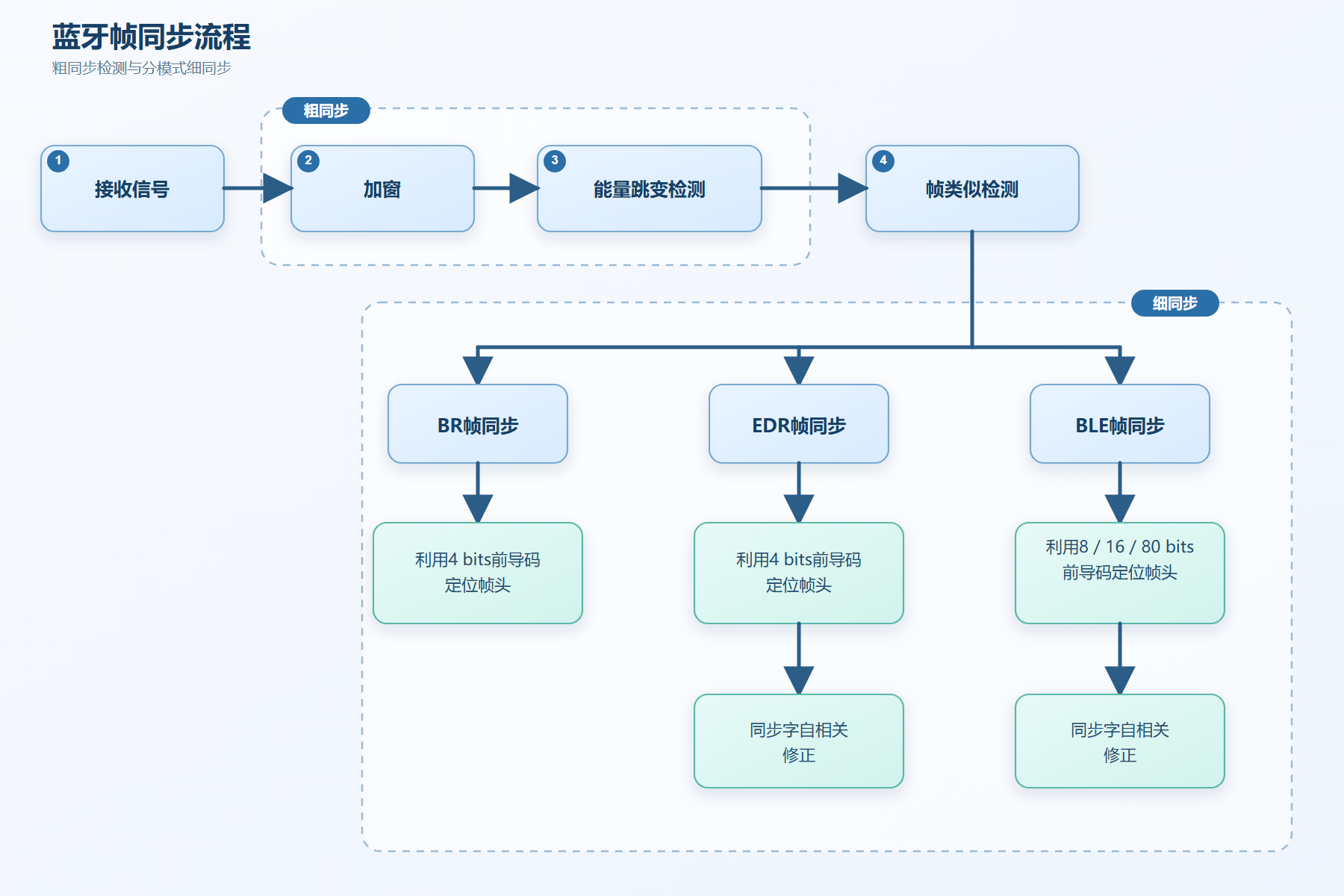
The invention patent "A Synchronization Method for Bluetooth Comprehensive Measuring Instrument Receiving Terminal Signal" adopts a two-stage scheme of "coarse synchronization+fine synchronization". The first stage is to perform Bluetooth frame header signal detection. The idea is to perform first-order differentiation on the receiving signal and use the impulse characteristics generated by the energy jump of the signal to find possible frame starting points; At the same time, combining the energy level and duration, distinguish real Bluetooth frames from short-term noise interference. In the second stage, a targeted fine synchronization scheme is adopted based on the different frame structures of BR, EDR, and BLE: the BR signal uses a 4-bit preamble for correlation positioning, and combines Access Code, Header, and Packet Type to verify the starting point; In addition to preamble correlation, EDR signals also use EDR synchronization words to correct the frame header position; The BLE signal is correlated with the 8-bit, 16 bit, and 80 bit preambles, and the starting point is determined by combining the peak value of the BLE synchronization word. This indicates that precise synchronization is not about measuring all Bluetooth signals with the same "ruler", but rather about first completing coarse-grained detection and then selecting a more suitable fine positioning method based on different modes. Its function is to provide a more reliable frame starting point for the receiving end before parsing and demodulation.
03. From waveform to bit: How GFSK demodulation resists interference
After completing recognition and synchronization, the Bluetooth synthesizer also needs to restore the received GFSK waveform to 0 and 1. GFSK is an important modulation method used in the BR and BLE physical layers, and the EDR frame header also uses GFSK. Its continuous phase and Gaussian filtering characteristics are beneficial for controlling the spectrum, but also require full consideration of channel noise and inter symbol correlation for demodulation at the receiving end.
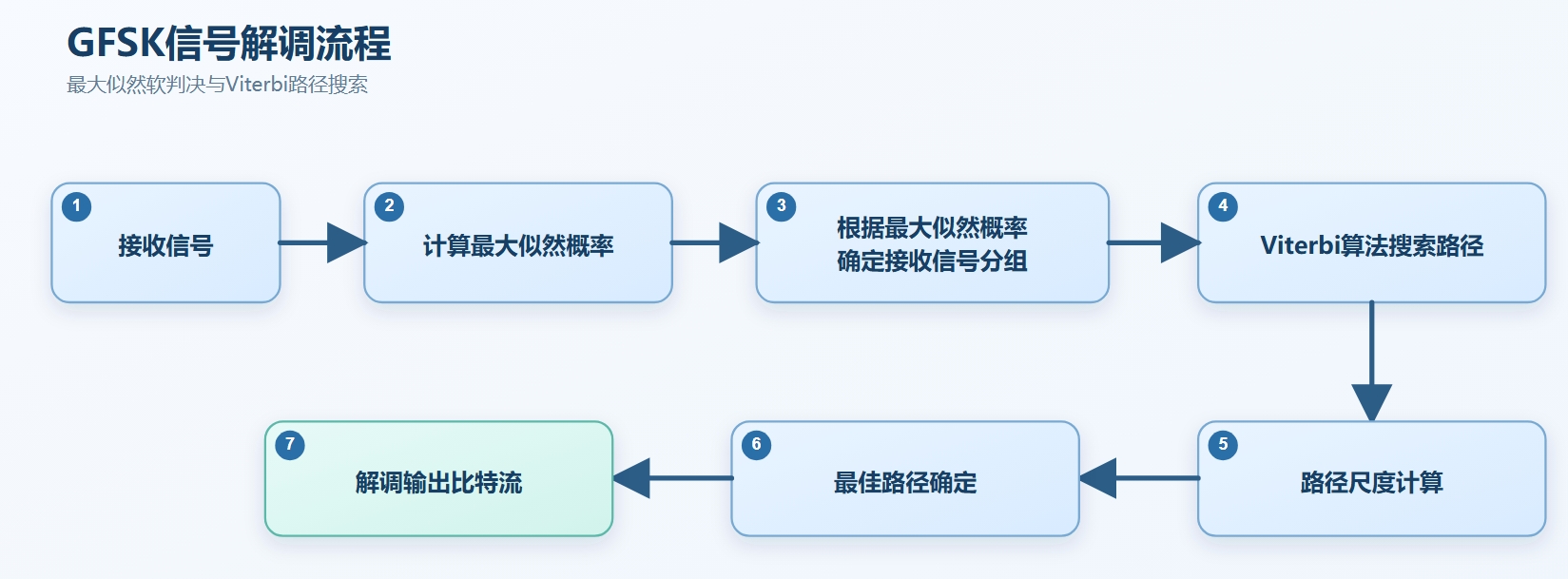
The invention patent "A demodulation method for GFSK signal of Bluetooth comprehensive tester" proposes a demodulation scheme that combines maximum likelihood probability and Viterbi search. This method first clarifies the GFSK modulation and Gaussian filter parameters based on the Bluetooth protocol, and establishes the wireless channel model of the Bluetooth comprehensive measuring instrument; Subsequently, based on the maximum likelihood probability theory, the probability of the received signal under the conditions of bit 0 and bit 1 is calculated, and a soft decision basis is formed; Finally, a Trellis grid is constructed using probability metrics as the path search scale, and the Viterbi algorithm is used to gradually preserve the optimal path and backtrack to obtain the demodulated bitstream. Compared to hard decisions that only consider the sign of a sampling point and judge it as 0 or 1 when it exceeds a threshold, soft decisions retain more information about how trustworthy this bit is. By utilizing the overall relationship between adjacent symbols and candidate paths through Viterbi search, more reasonable global decision results can be found under strong interference or noise conditions.
Application Scenarios
The receiving end processing capability formed by signal pattern recognition, reception synchronization, and GFSK demodulation can be applied to Bluetooth comprehensive testing instruments and related wireless testing equipment, mainly targeting the following scenarios:
R&D verification: Used for Bluetooth signal testing and debugging of products such as Bluetooth earphones, smart wearables, mobile phones, IoT terminals, etc., providing data basis for RF performance analysis in the R&D stage.
Automated production testing: During the mass production process, the received Bluetooth signals are automatically recognized, synchronized, and demodulated, and relevant parameter detection is completed by combining testing software, fixtures, and automation equipment to reduce manual operations and improve the efficiency and consistency of batch testing.
Wireless testing equipment development: Relevant algorithms can serve as an important component of the Bluetooth comprehensive testing instrument receiver, providing technical support for the functional development and performance optimization of wireless testing instruments.
From simply capturing wireless radio frequency signals, to accurately identifying signal patterns, locking signal frame headers, to fully parsing each set of bit data, the entire process is driven by a complete physical layer algorithm. Continuously researching the underlying core algorithms is not only an important foundation for domestic wireless testing equipment to improve testing accuracy, strengthen the ability to adapt to complex RF environments, and build core competitiveness in the industry, but also a solid foundation for Liankang Information to deeply cultivate the development and iteration of Bluetooth comprehensive testers, Bluetooth testers, wireless comprehensive testers, network analyzers and other instruments. We warmly welcome customers from all walks of life to inquire about product and technical details; If you have a customized testing plan concept, we also look forward to working together to negotiate and jointly develop and create technological achievements.
 Tel:173 9470 0835
 E-mail:support@lk-tek.com
 Add:No. 246 Wencheng East Road, Siyang County Economic Development Zone, Suqian City, Jiangsu Province