EN


In RF testing, testing instruments are often the most easily scrutinized. The equipment such as spectrum analyzer, network analyzer, signal source, and comprehensive testing instrument determine what the system can measure. However, after entering the stages of research and development verification, production testing, and batch testing, instruments alone are not enough. How to stably connect the test signal to the tested component? How to ensure consistent connection status between different samples? How to reduce the impact of manual operations, cables, and connectors on test results? How to balance testing efficiency and repeatability after entering batch testing? These issues are directly related to RF testing and treatment. The RF test fixture is not only used to fix products, but also an important link connecting DUT and testing system. It needs to simultaneously address issues such as stable connections, testing consistency, RF link errors, and automated testing.
The core testing pain points of RF Fixture RF testing fixtures
01. Core issues solved by RF testing fixtures:
Many RF test objects do not have standard RF interfaces for connection consistency, such as PCB test points, RF modules, antenna feed points, and patch interfaces, making it impossible to directly connect to testing instruments.

The RF test fixture establishes a stable and repeatable RF connection between the instrument and DUT through positioning, limiting, RF probes, and dedicated interfaces. Its core is not only to fix the product, but also to standardize the connection process, reduce manual operation differences, and provide a consistent connection foundation for subsequent RF testing.
02. Reduce the impact of connection links on test results
From connection to testing: What problem does the RF testing fixture solve?
The RF testing fixture should not only be "firmly connected", but also minimize its own impact on the test results. By maintaining a continuous impedance of 50 Ω, reducing switching and excessively long transmission paths, and controlling insertion loss, return loss, standing wave, and port isolation, the testing fluctuations caused by the connection link can be reduced. For high-precision testing, calibration, loss compensation, or embedding can be combined to further reduce errors.
03. Improve test repeatability and consistency
The RF test fixture maintains consistent testing conditions for each test by fixing the DUT position, unifying contact pressure, and standardizing connection methods, reducing data fluctuations caused by manual clamping, and improving test repeatability and comparability of results.
04. Improve batch testing efficiency
After entering mass production, testing efficiency often depends not only on instrument speed, but also on product clamping and connection efficiency. The RF testing fixture can simplify the originally scattered manual operations into:

The RF testing fixture reduces repeated wiring and disassembly time and shortens the testing cycle through fixed positioning, quick clamping, and replaceable probe structure. At the same time, it reduces the wear of DUT interfaces and concentrates vulnerable components at the fixture end for easy maintenance and replacement. The core consideration in the design of RF test fixtures is that different products have differences in structural dimensions, interface forms, testing frequency bands, and testing processes. Therefore, RF test fixtures usually need to be designed with specific DUTs and application scenarios in mind.
RF performance should be evaluated by selecting appropriate connectors, cables, and internal transmission structures based on the testing frequency, striving to maintain impedance continuity, and paying attention to indicators such as insertion loss, return loss, standing wave, and port isolation.
Interface and positioning methods need to be designed for different structures such as SMA interfaces, PCB test points, RF modules, antenna feed points, and spring clips, to ensure that the connection status after each clamping is as consistent as possible.
In the batch testing of repeatability and lifespan, it is necessary to ensure the repeatability positioning accuracy, clamping efficiency, and maintenance and replacement convenience of vulnerable components such as probes and connectors.
If it is necessary to integrate automation testing systems in the future, the requirements for pneumatic or electric control, status detection, multi port switching, and software linkage should also be considered in advance.
>Liankang Information | RF Test Fixture Customization
Based on the differences in structure, interface, and testing process of different products, Liankang Information can provide customized RF testing fixtures services. Combining specific DUTs, testing frequency bands, and application scenarios, targeted designs can be made for positioning structures, RF connections, probe solutions, clamping methods, and automation interfaces.
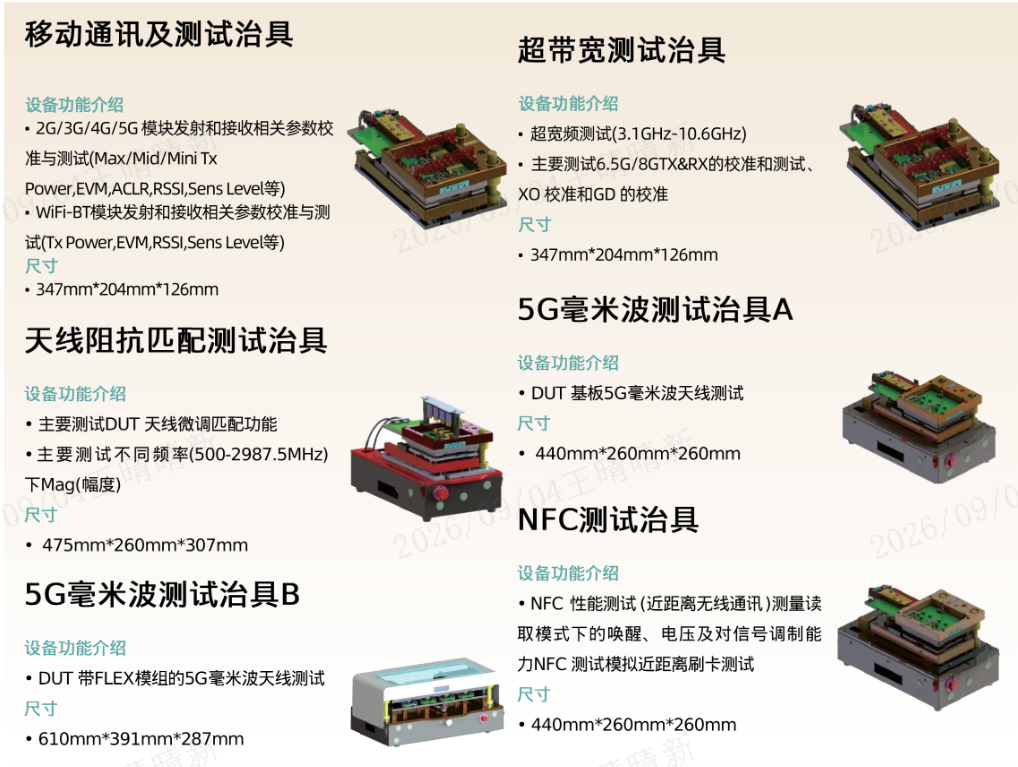
For PCB RF test points, RF modules, antenna feed points, wafer interfaces, and other non-standard RF interfaces, Liankang Information can design fixture solutions based on actual testing needs, and configure them in different scenarios such as R&D verification, mass production, or automated testing. If there are problems such as unstable connections, fluctuating repeated test data, low manual clamping efficiency, or the need for further integration into automated testing systems in the existing testing process, the RF testing fixture can also be used as a starting point to optimize the testing connection scheme.
 Tel:173 9470 0835
 E-mail:support@lk-tek.com
 Add:No. 246 Wencheng East Road, Siyang County Economic Development Zone, Suqian City, Jiangsu Province