EN


In the semiconductor testing process, the probe card is responsible for the electrical connection between the tested device and the testing system. With the continuous increase in the number of probes and testing density, high-density probe cards often contain thousands of TP testing points, which puts higher requirements on the number of testing channels, measurement accuracy, switching efficiency, and data management.
Liankang Information has developed a comprehensive testing machine for probe cards targeting 6000 TP points. Through large-scale channel switching, automatic measurement, and software control, it achieves automated detection of multiple electrical parameters such as leakage current, resistance, capacitance, open circuit/short circuit, etc., meeting the application needs of probe card production testing, shipment inspection, and maintenance retesting.
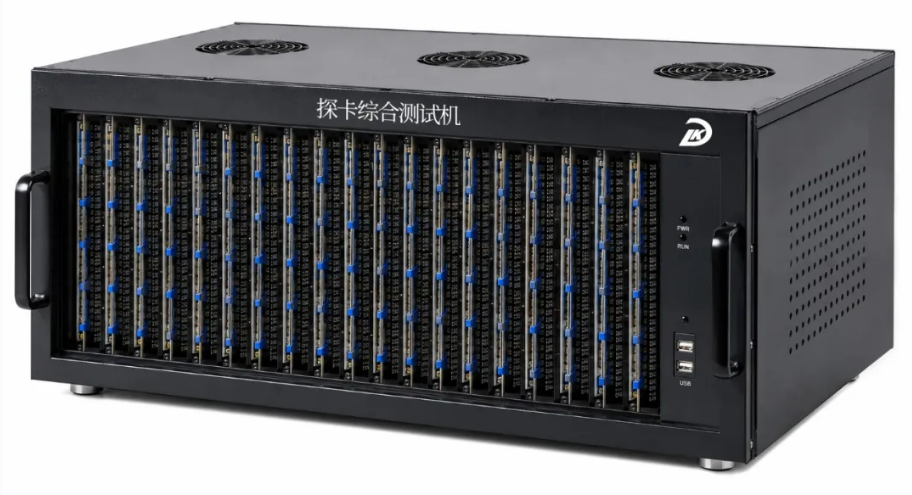
Liankang Tanka Comprehensive Testing Machine
6000 TP points, not just leakage current detection
The probe card integrates a large number of probes, circuits, and connection structures internally. During processing, assembly, and long-term use, problems such as leakage, abnormal resistance, abnormal capacitance, open circuit, short circuit, and abnormal connection may occur. Therefore, high-density probe card detection cannot only focus on a single indicator, but requires comprehensive judgment of the test channel status from multiple electrical parameters.
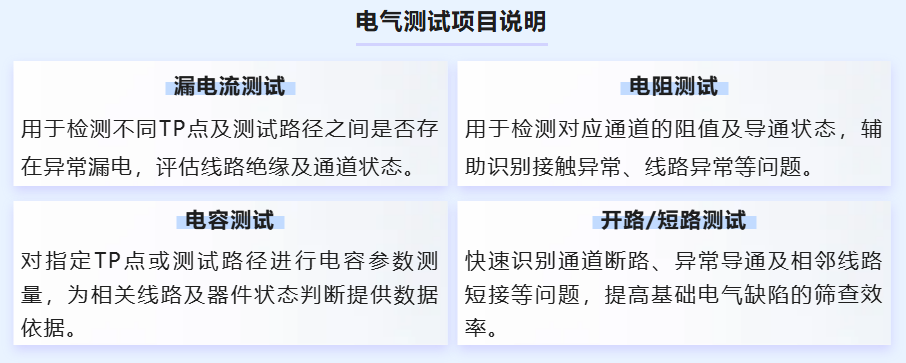
By integrating multiple testing capabilities into the same system, device switching between different detection items can be reduced, and the comprehensive detection efficiency of high-density probe cards can be improved.
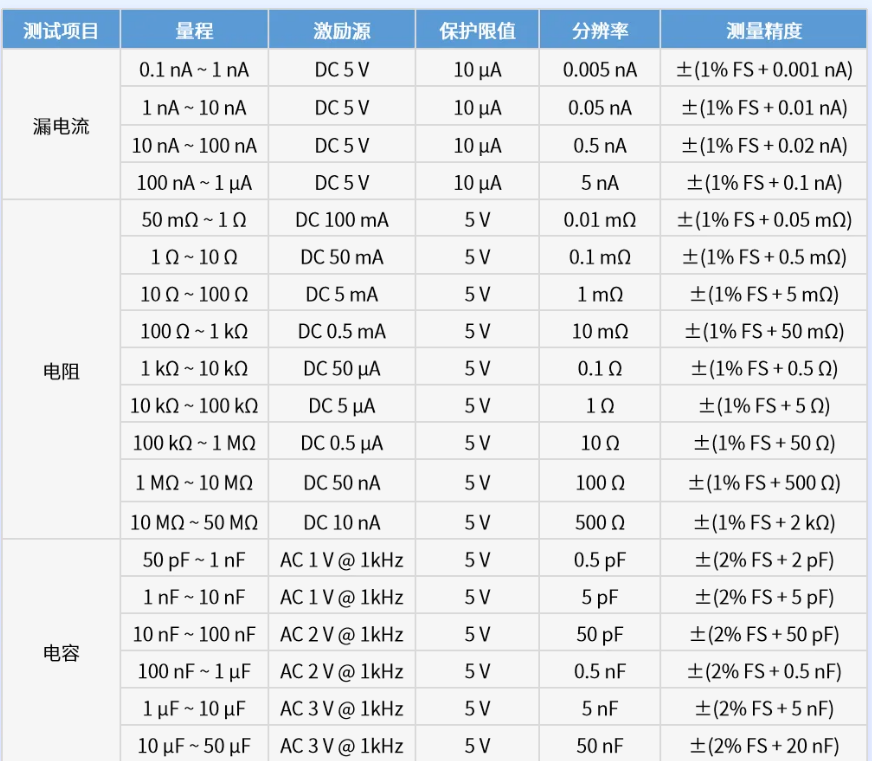
Design parameters of source measurement unit and switch board for the comprehensive testing machine of Tanka
The core difficulty of testing 6000 TP points
Increasing from dozens of test points to 6000 TP points is not simply about enlarging the number of test channels. What really needs to be addressed is:
1. Switching 6000 TP points in large-scale testing channels corresponds to a large number of testing paths. Traditional manual wiring and point by point switching are not only inefficient, but also prone to misconnection, missed testing, and repeated testing. The system needs to automatically establish test circuits between different TP points through large-scale switching and control boards according to the testing program, and complete channel scanning in the set order. By controlling channel switching through programs, thousands of test points can be integrated into the automated testing process.
2. The consistency of multi parameter measurement for leakage current, resistance, capacitance, and open/short circuit testing corresponds to different measurement conditions, with corresponding requirements for signal paths, switching devices, connecting cables, testing interfaces, and system grounding. Especially in detecting small leakage currents, the leakage generated by the testing link itself and external interference may affect the measurement results. Therefore, the system needs to plan the testing path, board design, interface connections, and structural layout uniformly to ensure consistency of testing conditions between different channels.
3. Large scale testing data management: 6000 TP testing points corresponding to multiple testing projects will generate a massive amount of testing data. The system needs to establish a complete mapping relationship between TP point number, test items, test conditions, measurement results, and PASS/FAIL determination. Through standardized data recording and automatic judgment mechanisms, we can eliminate the dependence on manual reading of instrument data, while providing complete and traceable data support for abnormal retrospective, equipment maintenance, and retest traceability.
From manual point by point detection to automatic scanning for high-density probe cards, manual testing requires a series of operations such as point finding, wiring, parameter configuration, measurement, result determination, and data recording to be repeated. As the number of TP points increases, the testing cycle is significantly extended, and the risk of errors caused by human operation also increases significantly.
The Liankang card leakage current testing machine relies on the testing program to achieve unified process control. The execution chain is as follows: probe card access → TP point call → automatic channel switching → test project execution → data acquisition → threshold judgment → PASS/FAIL result output → abnormal point recording
After completing the detection of a single TP point, the system automatically switches to the next testing path without the need for operators to repeatedly plug and unplug wiring. The equipment can complete multiple tests such as leakage current, resistance, capacitance, and open/short circuit according to testing requirements, transforming fragmented manual testing operations into a continuous and reproducible automated scanning testing process.
Rapid positioning of abnormal TP points
In large-scale probe card testing, anomaly localization and data tracing are particularly important. The testing software automatically associates the TP point numbers with the corresponding test results.
For example:
TP0001 | Leakage Current | PASS
TP0002 | Resistance | PASS
TP0003 | Open short circuit | FAIL
……
TP6000|PASS
After detecting anomalies, further inspection of the corresponding TP point's testing items, measured data, and judgment results can be conducted to quickly locate the location of the anomaly and reduce manual point by point troubleshooting. This data-driven management approach is beneficial for improving the efficiency and traceability of probe card production testing, shipment inspection, and maintenance retesting.
System collaboration of "instrument+board+fixture+software"
The multi parameter testing of 6000 TP points is not completed by a single instrument, but is composed of multiple hardware and software modules.
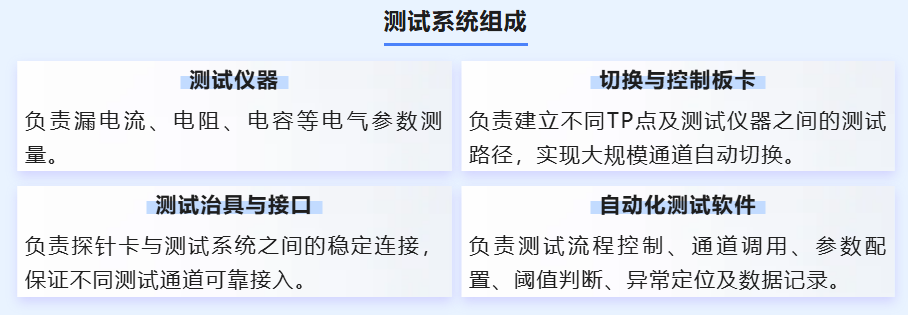
Through the collaboration of instruments, boards, fixtures, and software, thousands of testing points and multiple testing projects can be unified into the same automated testing platform. For the 6000TP level high-density probe card, the testing requirements have shifted from simple "point by point measurement" to large-scale channel management, multi parameter testing, and automatic data tracing.
Consultation on customized solutions
For different probe card structures, TP point quantities, and testing projects, Liankang Information can also configure corresponding testing channels and processes according to actual application needs, providing automated testing solutions for semiconductor probe card production, testing, and maintenance. If you have any requirements for the selection, customized development, and technical consultation of probe card automation testing systems, please feel free to communicate with Liankang Information Technology customer service~
 Tel:173 9470 0835
 E-mail:support@lk-tek.com
 Add:No. 246 Wencheng East Road, Siyang County Economic Development Zone, Suqian City, Jiangsu Province