EN

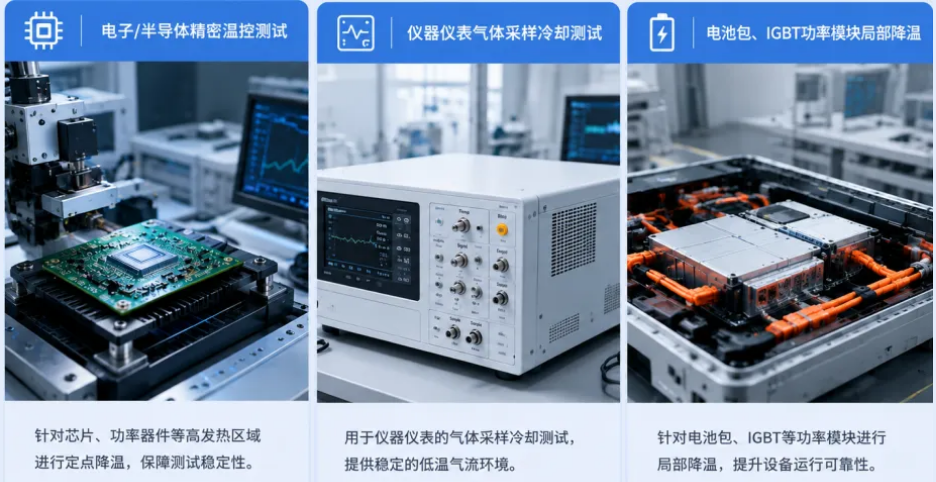
In the research and production testing of electronic products, chips, power devices, and PCB high load areas are prone to local hotspots when continuously powered on and running at high loads. The internal space of testing fixtures, shielding boxes, and automation equipment is narrow, making it difficult for heat to dissipate. Continuous operation can cause temperature accumulation, which in turn affects the operating status and testing stability of the devices. Whole machine air cooling or environmental cooling requires overall temperature control over a large area of space, which is costly and lacks specificity. For scenarios where the heat source is concentrated and the location is fixed, fixed-point cooling at key heating points is more suitable for testing system integration requirements. Vortex tubes are suitable for such local cooling scenarios.
Vortex tube: delivers cold air directly to the heating area
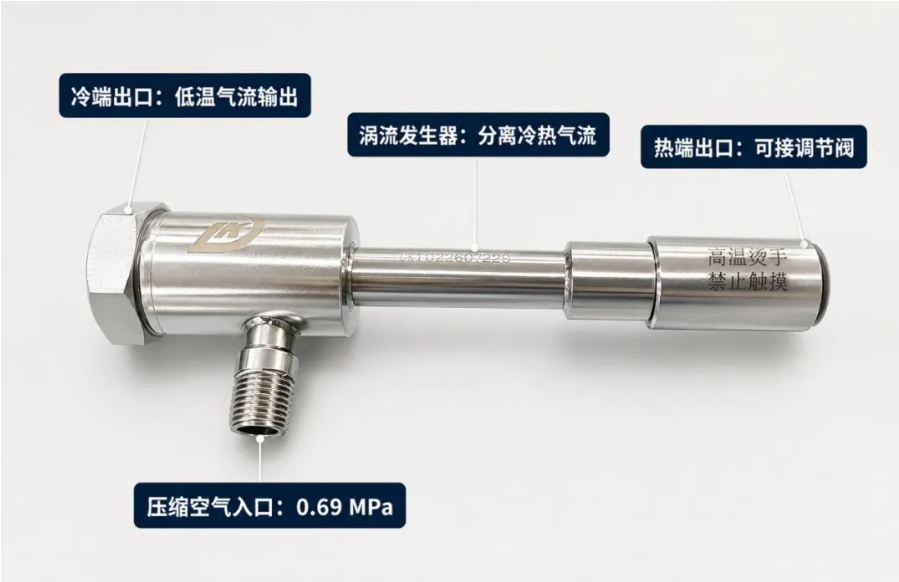
The vortex tube uses clean compressed air as its power source, separates cold and hot air flows through internal airflow, and outputs low-temperature air flow from the cold end. By combining the design of the trachea, nozzle, and equipment structure, cold air can be accurately delivered to the target heating area, forming a refrigeration path of "compressed air input vortex cold and hot separation cold end output directional air supply local heat source cooling". Compared to overall cooling of the entire testing space, this method is more suitable for implementing fixed-point temperature control according to the location of the heat source. It can be applied to scenarios such as PCB high heat chips, testing fixtures, and automated testing stations, and can be integrated as a local temperature control module into the testing system.
Why are vortex tubes suitable for testing equipment integration?
The vortex tube operates with clean compressed air, without the need for a refrigerant system or complex moving parts such as bearings and pistons. It has a simple structure and low maintenance requirements, making it suitable for embedding into automated production lines with existing air sources
Testing equipment.
Pure pneumatic operation
The vortex tube works directly with compressed air without the need for additional refrigerant systems, making it easier to integrate in automated production lines and testing equipment with existing air sources.
No complex moving parts
There are no moving parts such as bearings or pistons in the structure, making it highly reliable and suitable for continuous operation 24/7.
Flexible air conditioning output position
The cold air path can be planned based on the testing fixture, DUT location, and local heat source distribution to make the cooling area more concentrated.
Suitable for narrow testing spaces
The miniaturized structure can be arranged inside fixtures, equipment, or near workstations, especially suitable for testing systems with limited overall space but significant local heating.
Local cooling also needs to be matched with the thermal load
The selection of vortex tubes should not only focus on the cold end outlet temperature, but also need to be comprehensively judged based on the thermal load of the tested device, the target cooling area, the inlet conditions, the installation space, and the continuous testing time. The existing series of LK small vortex tubes from Liankang Information covers different cooling power specifications under standard 6.9 Bar intake conditions, and can be matched with various local temperature control testing needs. The core parameters of each model are as follows:
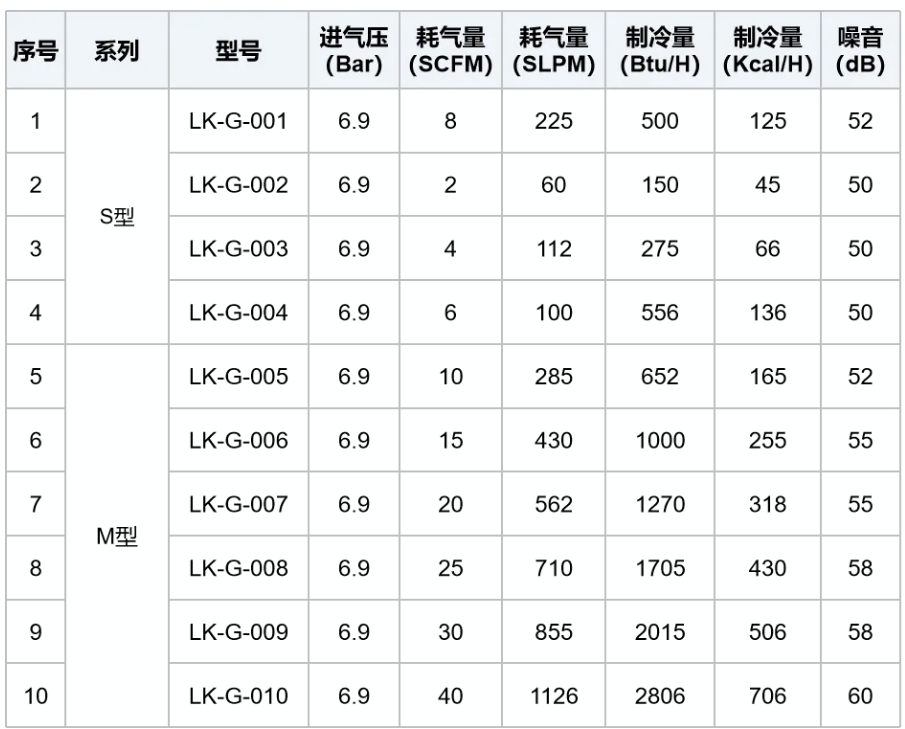
The S-type tends to have small and medium flow rates and cooling capacities, making it more suitable for precision components, small fixtures, and local testing stations;
The M-type has a larger air flow and cooling capacity, and can be used for devices with higher heat generation and concentrated heat dissipation areas.
Application Scenarios
Consultation on customized solutions
Liankang Information relies on the application accumulation of testing fixtures, shielding equipment, and automated testing systems to achieve the serialization and standardized development of vortex tubes. As a local temperature control module, it is suitable for multiple electronic testing scenarios. Interested parties are welcome to consult.
 Tel:173 9470 0835
 E-mail:support@lk-tek.com
 Add:No. 246 Wencheng East Road, Siyang County Economic Development Zone, Suqian City, Jiangsu Province