EN


With the increasing adoption of millimeter-wave technology in electronic products, testing requirements for electronic motherboards have become more demanding in terms of RF isolation, test consistency, and mass production efficiency. In practical testing scenarios, multiple motherboards operating simultaneously may cause mutual interference between millimeter-wave signals, affecting measurement accuracy and stability. Meanwhile, motherboard positioning, test connections, pneumatic pressing, and thermal management directly affect testing stability and production efficiency.
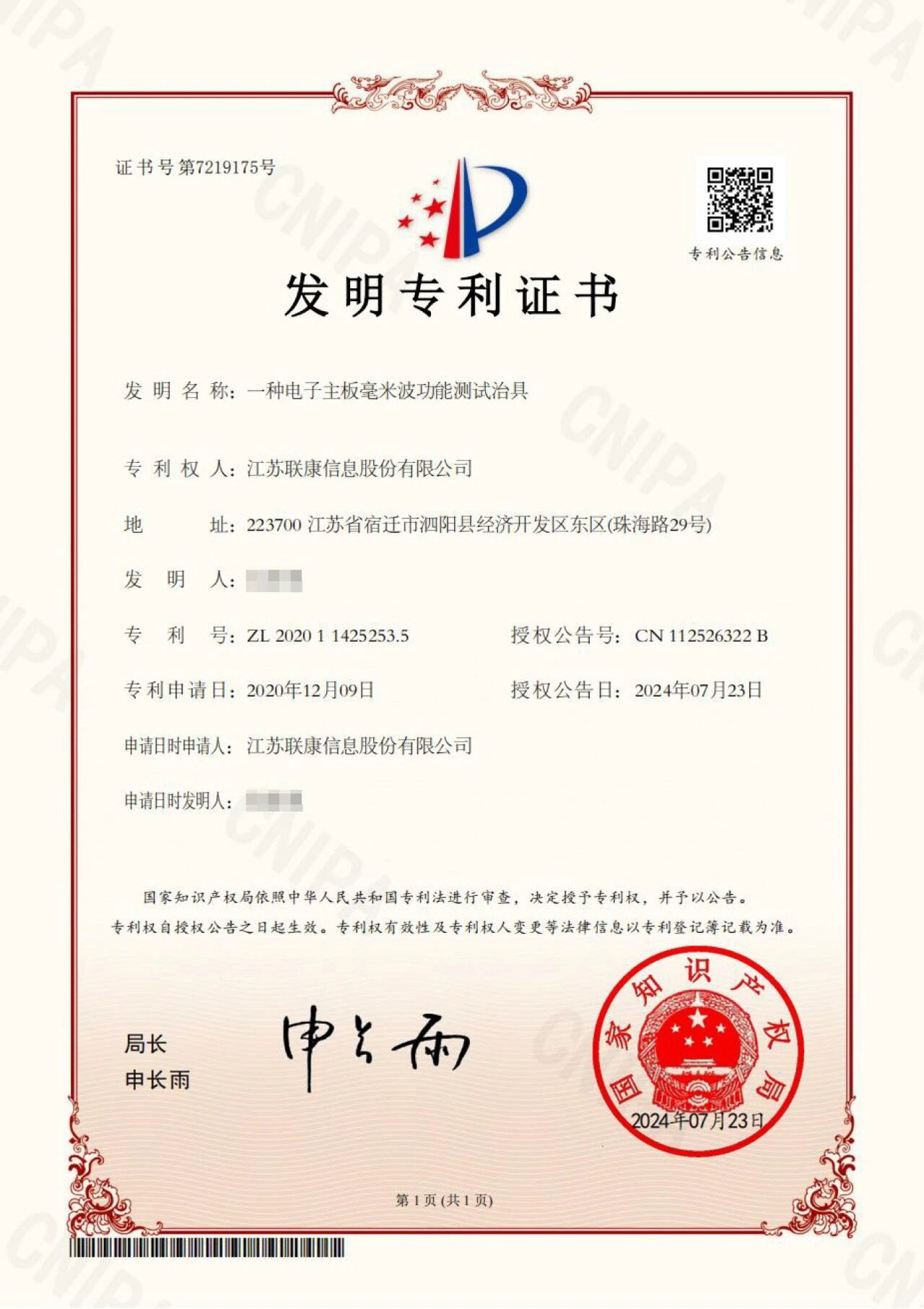
To address these challenges, the Liankang Information R&D team developed an integrated fixture that combines millimeter-wave shielding, motherboard positioning, probe testing, pneumatic pressing, and thermal management structures into a single solution, providing stable and efficient support for millimeter-wave functional testing of electronic motherboards. This innovation has been granted a national invention patent titled "A Millimeter-Wave Functional Testing Fixture for Electronic Motherboards" (Patent No.: ZL 202011425253.5).
Enhancing Millimeter-Wave Testing Efficiency Through Signal Isolation, Multi-Board Testing, and Integrated Fixture Design
01 Reduce signal interference in multi board testing
Millimeter-wave testing is highly sensitive to environmental conditions. When multiple DUT motherboards are placed in the same test environment, RF signals between different boards may interfere with each other, affecting measurement accuracy. This patented fixture incorporates a millimeter-wave shielding enclosure with multiple independent shielding cavities. RF absorbing structures are installed inside each cavity, allowing the millimeter-wave antennas on each motherboard to correspond to dedicated test spaces. During testing, the fixture base board and shielding enclosure create a relatively isolated test environment, reducing signal interference between different DUTs and providing more stable conditions for RF performance testing.
02 Supporting Synchronous Testing of Multiple Motherboards
The Traditional single-board sequential testing methods are limited by test cycle time during mass production. The fixture uses a multi-cavity structure to place different DUT motherboards in independent millimeter-wave test spaces, reducing mutual interference while supporting synchronous functional testing of multiple boards. Compared with single-board testing, this solution increases the number of DUTs tested per cycle, shortens batch testing time, and is better suited for automated production testing.
03 Integrated positioning, connection, and compression functions
In addition to the millimeter wave shielding structure, this patent also integrates the motherboard positioning, electrical connection, and pressing and contact functions into the same fixture. The DUT motherboard is fixed and positioned through the fixture base board, upper board module, and guiding structures; The test probes in the upload board module make contact with the test points on the motherboard to achieve power on and test signal connection. At the same time, the fixture adopts a pneumatic structure to complete compression and reset, so that the product maintains consistent positioning during repeated tests during repeated testing, which is conducive to improving testing repeatability and reducing manual compression operations.
04 Meeting Thermal Management Requirements During Continuous Testing
Electronic motherboards generate heat during continuous power-on testing, and temperature increases may affect test stability. To address this challenge, the fixture integrates dedicated air ducts and cooling structures to dissipate heat through airflow. This design meets thermal management requirements during continuous testing and provides more stable operating conditions for batch production testing.
The diagram shows the unfolded structure of the testing fixture for this patent (including 1-fixture chassis, 2-fixture base, 3-U-plate sliding component, 4-millimeter wave shielding box, 5-download board, and 6-upper needle board carrier module)
Application Scenarios
In practical applications, this patented fixture is not simply a millimeter-wave shielding structure, but an integrated solution combining RF isolation, multi-board testing, motherboard positioning, electrical connections, pneumatic pressing, and thermal management functions.
Its key application benefits include:
Signal Interference Reduction: Improve millimeter-wave test environment isolation through independent shielding cavities and RF absorbing structures.
Testing Efficiency Improvement: Support synchronous testing of multiple motherboards and increase the number of DUTs tested per cycle.
Testing Consistency Improvement: Reduce positional variation during repeated testing through precise positioning, probe connections, and pneumatic pressing.
Mass Production Suitability: Integrate testing connections, control functions, and thermal management into one fixture, enabling easier deployment in production testing and automated testing environments.
For millimeter-wave motherboard testing, a successful solution must address not only functional verification requirements but also critical challenges such as RF isolation, test repeatability, and production efficiency. Through the integrated design of millimeter-wave shielding structures and test fixtures, Liankang Information provides a reliable testing solution that improves test stability and scalability, supporting R&D validation and mass production deployment of advanced electronic products.
 Tel:173 9470 0835
 E-mail:support@lk-tek.com
 Add:No. 246 Wencheng East Road, Siyang County Economic Development Zone, Suqian City, Jiangsu Province